Stop Getting Burned
With the independent test data that never makes it onto the label
Secure checkout · Visa · Mastercard · PayPal · Apple Pay
I · The Problem
The two mistakes
You've bought the expensive one and watched it break. You've bought the cheap one and watched it never work in the first place.
Somewhere between those two is the thing that actually would have worked, and it usually costs less than you'd think. It's just never the one the box points you toward.
Add up what that's cost you. Not one bad purchase — all of them, going back five years. The tool that lasted a season. The appliance that needed a service call in year two. The bottle of something that's been sitting under the sink since the one time you used it, because it didn't do what the front of the label said it would.
Most people are into four figures on this and have never once sat down and counted it, because each individual mistake was small enough to shrug off.
That's the whole trick of it. No single one of them is worth being angry about. Together they're a real amount of money.
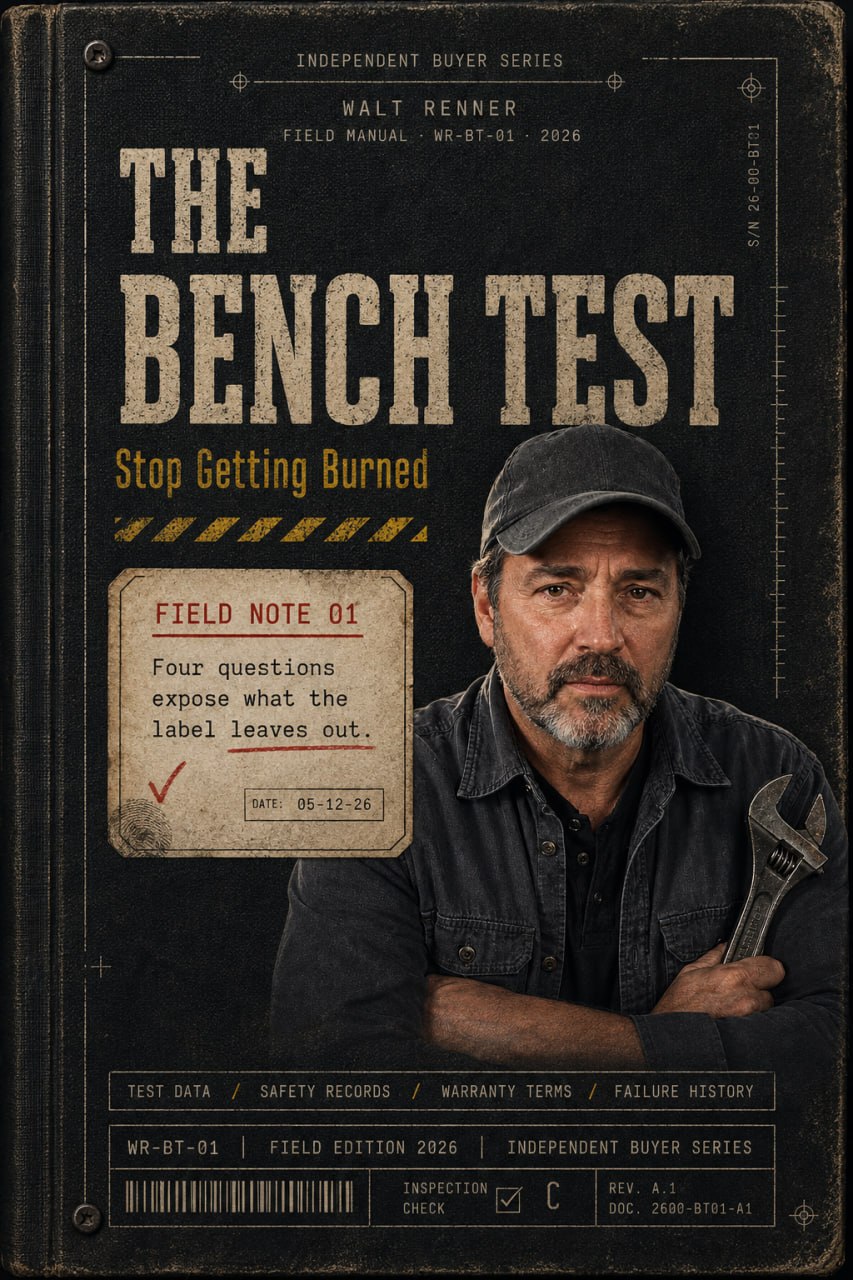
The four questions I run before I buy anything — and the map to every number the label leaves out.
Every chapter runs the same shape: what the box claims, who actually measured it, what they found, and what it still will not tell you.
II · The Math
What one wrong guess costs
The Bench Test is $49.
That's not a promise of savings, and it isn't an average. It's one worked example at ordinary retail prices, and it adds up in front of you. Cross off the ones you haven't done. Add the ones I missed. Every line is something the four questions would have caught before the money left your hand.
| What went wrong | What it cost |
|---|---|
| Mattress that sagged inside eighteen months | $899 |
| Tires that wore out at 25,000 on a 60,000-mile rating | $758 |
| Laptop that throttled under the load it was sold for | $729 |
| Dishwasher that died in year three | $649 |
| Portable AC that couldn't hold the room it was rated for | $349 |
| Washing machine that needed a service call in year two | $285 |
| Robot vacuum that quit mapping the month after the warranty | $279 |
| Cordless mower battery that wouldn't finish the yard | $254 |
| Air purifier whose filter subscription outlasted the unit | $222 |
| "Professional grade" pressure washer, replaced in eighteen months | $219 |
| Cordless drill that couldn't hold a charge past year one | $129 |
| Space heater that failed three weeks after the return window closed | $119 |
| Neck fan that died halfway through the shift you bought it for | $89 |
| Ceramic coating that didn't survive the first chemical wash | $69 |
| Fourteen mistakes, five years | $5,049 |
| The Bench Test | $49, once |
Ordinary retail prices, not test results, and not a claim about what you'll spend. Your fourteen are different from my fourteen. That's the point — everybody has fourteen.
III · Why This Exists
What happened to me
A few years back I was getting a truck ready to sell. Washed it, detailed it, the whole thing, because a clean truck gets a better offer and I wanted the better offer.
I paid extra for a ceramic coating. Not the cheap one — the one with the most reviews and the highest star rating I could find, the one every comment section swore by. My logic was that this was the one purchase worth not cheaping out on.
Three weeks later the buyer ran his hand across the hood in the sun and asked why it was already swirling.
I lost real money off the asking price that day. Over a product I had specifically paid more for so that exact thing wouldn't happen.
The money wasn't the part that got me. It was what I found when I went looking for why.
Those five-star reviews weren't lying, exactly. They just weren't testing anything. Not one person who left one had run that coating against a strip wash or a chemical round. They'd sprayed it on, watched water bead on the hood for a week, and given it five stars.
And the number that would have told me the truth — an independent chemical-resistance test, run by people with no stake in the outcome — existed. It had existed the whole time. It just wasn't anywhere near the listing, and I never thought to go look for it, because the stars looked like enough.
A five-star average and an actual test are two completely different things wearing the same trusted costume. Almost nobody knows how to tell them apart while they're standing in an aisle with a card in their hand.
IV · The Method
So I made a checklist
I got tired of guessing, so I wrote down the questions I should have asked before I bought that coating. Four of them. I run everything through them now — a $17 bottle, a $500 appliance, doesn't matter.
Is there a number, or just a feeling word?
"Long-lasting." "Professional grade." "Whisper quiet." None of those are numbers. Hours, decibels, pounds of force, parts per billion — those are. If the listing won't give you a number, that's the first flag, not the last.
Who ran that number — the company, or somebody with no reason to lie about it?
A number a manufacturer generated about its own product isn't nothing. It isn't the same thing either.
Does the expensive one actually win, or does it just cost more?
Price tells you what you're paying. It has never once told you what you're getting.
What does it look like two years in?
The failure that cost me money didn't show up in week one. It showed up in week three. A five-star review from somebody seven days into ownership is a different category of evidence than a test that ran the thing until it broke.
I call it the Bench Test. It's the only credential I've got, and it's the entire product.
V · The Manual
What this actually is
The Bench Test is an 814-page PDF: 75 chapters across 15 sections, then four reference sections at the back.
The chapters are organized the way aisles are — oils and fluids, hand tools, power tools, fasteners, adhesives, safety gear, lawn and outdoor. Each one takes a single category, states what the packaging claims, describes the rig somebody actually used, reports what it found, prices the field as it was tested, and closes on what to look for and what the evidence can't support. The method runs through all of them rather than sitting in its own chapter, because a method you read once and a method you watch get used seventy-five times are different things.
The four sections at the back are the part I wish I'd had. The Source Directory is where independent test data actually lives — free databases, public records, complaint registries, certification directories — with the real search steps and what each one is bad at. The Label Decoder is every mark and phrase on a box and who stands behind each one. The Warranty Chapter is what the law obliges a warranty to do and what it was never going to cover. The Aisle Card is the short version, for use in front of a product.
No brand rankings that expire in fourteen months. Every number in it belongs to somebody who is named in the same paragraph, on a rig that is described so you can judge it.
VI · Contents
What's inside
- The label language that means the manufacturer ran the test on its own product, and why a disappointing in-house result never reaches the boxp. 791
- The federal recall database anyone can search in forty seconds, and why almost nothing in it ever reaches the product pagep. 779
- "Meets" versus "certified to" a standard, and why one of those is close to meaninglessp. 789
- How to find the actual standard number governing a category, and read what it does and doesn't measurep. 39
- The seal with no issuing body behind it, and how to tell a mark an outside lab stands behind from one the seller signed for itselfp. 789
- A runtime printed on the box with no setting named beside it — ninety minutes on which one — and the eight vacuums run to exhaustion to find outp. 620
- Decibel ratings and the distance they were measured from, which is the part nobody printsp. 666
- What a review-date cluster looks like, why a rating average hides it, and what it does and doesn't tell youp. 799
- Why "verified purchase" does not mean what most people assume it meansp. 798
- The hardness rating used across an entire product category that was measured on a surface with nothing to do with the productp. 792
- Warranty length as a confidence signal about the steel, and the failure a lifetime warranty turns out not to coverp. 163
- How to read the spec sheet against the claim on the front of the same box — they frequently disagreep. 799
- Class-action filings as a failure database, and how to search one for freep. 783
- "Professional grade" has no legal definition in any category. What to look for insteadp. 790
- The complaint registry for anything that goes on a vehicle, and how to sort it by failure typep. 781
- What three brands at three prices leaving one factory actually looks like, why it doesn't prove what everyone says it proves, and the two records that would settle itp. 793
- MSRP that was never actually charged, and how to check what a thing has really sold forp. 797
- Award badges and "as seen in" logos, the federal rule that governs them, and the check that tells you whether one means anythingp. 793
- Why a return window is structurally incapable of catching a duration failure, however long it runsp. 110
- How to find out whether the study a brand is citing was funded by the brand citing itp. 785
VII · Sourcing
Where the numbers come from
I don't run a lab. I go find the people who did, and I name them every time.
Project Farm's bench tests. Consumer Reports' member survey data. CNN Underscored and TechGearLab's independent comparisons. Yale Appliance's service-call records. CPSC recall records. Actual class-action filings.
Every one of those is in the directory, along with a dozen more, with instructions for searching each one yourself.
The point isn't to take my word for it. The point is that you shouldn't have to.
No review units. No sponsorships.
No brand has ever paid to be on a winner list or kept off an avoid list.
VIII · The Offer
What you get for $49
| The Bench Test — the method, four questions taken apart one at a time | $39 |
| The Source Directory — every free database, registry and standards body, with search steps | $44 |
| The Category Files — the method run start to finish on six real products, one per category | $34 |
| The Label Decoder — every mark and seal on a box, who issues it, and whether it's self-issued | $26 |
| The Warranty Chapter — what the law obliges a warranty to do, the aftermarket-parts rule that gets told wrong both ways, and how to read one before you pay | $22 |
| The Bench Test, read aloud — audio edition of the method, for the drive or the shop | $22 |
| The Aisle Card & Search Sheet — printable wallet card, plus copy-paste queries for every database | $16 |
| Every future edition — new sources, free, permanently. No upgrade tier | included |
| Sold separately | $203 |
| You pay today | $49 |
Every one of those is a real listing you can go buy on its own, at that price — click any of them and check. Page 797 of the manual is about prices that were never actually charged, so I'm not going to print one on my own sales page.
Get The Bench Test — $49 Instant download · yours permanently, updates includedSecure checkout · Pay once · Yours forever
IX · Limits
What this won't do
It won't tell you the best coffee maker. That's not what it is, and any list like that is wrong within a year anyway.
It won't make you an expert in any category. It'll make you hard to fool in all of them, which is a different and more useful thing.
And it won't help at all if you're the kind of person who genuinely enjoys buying the expensive one. Nothing wrong with that. This is for people who want the one that works.
X · The Author
Who's telling you this

My name's Walt. I've got a garage full of tools like anybody else's and no credential worth printing.
What I've got is the exact same feeling you've had standing in an aisle with a card in your hand, not sure which one of these is lying to you. I've been on the wrong end of that enough times that I stopped taking the box's word for it and started going and finding who'd actually run the numbers.
That's all this is. Somebody already did the hard part. Most people just never find out where they put it.
XI · Questions
Before you buy
Is this a list of product recommendations?
No, and that's deliberate. A ranked list is wrong within a year — new models, new formulas, new suppliers. This is the method that produces the list, plus the places to go get current numbers yourself. It doesn't expire.
How is this different from just watching the videos?
The videos show you the answer for one category. This shows you how the answer gets found, in any category, including the ones I'll never cover. If you've ever wanted to run the same check on something I haven't made a video about, this is that.
I already read reviews carefully. Won't this be obvious?
I thought I read carefully too, right up until a hood full of swirl marks proved otherwise. Most of the book isn't about reading reviews better — it's about the public test data and federal records sitting one search away from the listing, that almost nobody knows exist.
Do I need to be handy or technical?
No. If you can read a product listing on your phone, you can run all four questions. Nothing in it requires tools, a shop, or knowing what a torque spec is.
What format is it, and what do I need to read it?
A PDF. It opens on a phone, tablet, laptop, or e-reader, and it prints. Delivered instantly after checkout — no app, no login, no subscription.
Do brands pay you?
No. No sponsorships, no review units, no affiliate links, and no brand has ever paid to be on a winner list or kept off an avoid list. That's the only reason any of the rankings mean anything.
What if it isn't for me?
Then don't buy it. Section IX above is the honest list of what this won't do, and I'd rather you read that twice than order something that isn't for you. Everything I can tell you about what's inside is on this page before you spend anything.
XII · Order
YES — I Want The Bench Test Instant download · $49 launch price · yours permanently, updates includedSecure checkout · Visa · Mastercard · PayPal · Apple Pay
Launch price ends in under 10 hours. After that it's $79.